Runway End Safety Areas (RESA)
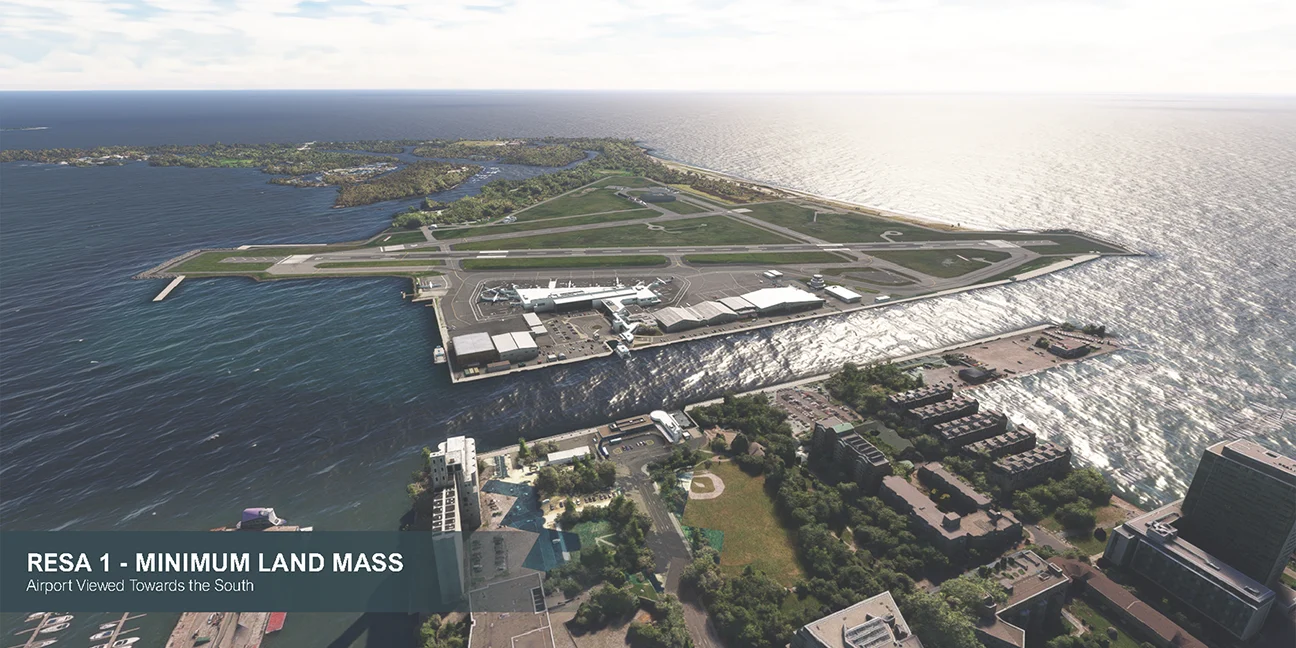
On July 16, 2026, the Toronto Port Authority began construction of two new Runway End Safety Areas (RESAs) at Billy Bishop Toronto City Airport as part of a federally mandated safety enhancement project. Commencement of the project follows an Environmental Assessment that was conducted in 2024, and approval by the City of Toronto in October 2024. Required by Transport Canada, RESAs are cleared and graded safety areas located beyond the ends of active runways. They are designed to provide an additional margin of safety in the unlikely event that an aircraft travels beyond the runway, helping to reduce the severity of potential aircraft damage and enhancing safety for passengers and crew.
Video Overview
Frequently Asked Questions
The RESA project is required by Transport Canada. It fulfills Transport Canada’s national directive to enhance runway safety and align Canadian commercial airports with current domestic and international aviation standards as outlined in Transport Canada’s Regulations Amending the Canadian Aviation Regulations (Parts I, III and VI — RESA): SOR/2021-269.
Yes – you can find the Environmental Assessment, including appendices, below.
Construction is taking place overnight, to permit normal airport operations during the day. Construction activities will be intermittent during the construction period. Construction hours are between 11 PM and 6 AM, Monday to Saturday, with staging occurring from 9 PM onward. Material delivery from the Port Lands staging sites to airfield will occur as a 24-hour operation. Construction start and end times may vary slightly due to weather or aviation-related operational matters.
This schedule was designed to reduce impacts on airport operations and to normal daytime activities in the Inner Harbour and Western Channel.
While the runway will be closed, helicopter medical evacuations will be preserved to ensure these life-saving operations are not interrupted.
During the day, you may see vehicles and vessels stockpiling materials on the south side of the airport. For a visual representation of what is happening overnight, watch our informational video above.
At any point during the construction period, you may see in and around the Inner Harbour and construction site, the following vessels and vehicles: material barges and loaders, a self-unloading vessel, long-reach excavators, D6 bulldozer and 950 loader.
2026
- Final Design and Permitting: January to July
- NAV CANADA Navigational Aid Modifications: April to May
- In-Water Construction Start: Mid-July
2027
- In-Water Work Complete: early 2027
- Landmass Compaction and Grading of Fills (above water): March to May
- Revetment/Armour Stone Final Adjustments (above water): March to May
- Airfield, Security Fence and Perimeter Road Restoration: June to Late Fall
- RESA Compliance Work Completed: July
- Aquatic Habitat Restoration / Shoreline Enhancement: Summer/Fall
2028
- Aquatic Habitat Restoration / Shoreline Enhancement: Spring/Fall
- Ongoing monitoring of habitat restoration work will continue past 2028
Toronto Port Authority is working with Avia NG and AECOM (planning and environmental assessment); EllisDon Civil Ltd. teamed with Stantec and J.F. Baird (design-build).
The project will not extend the active runway, facilitate the use of new aircraft, or increase operations at the airport.
The boundaries and size of the existing Marine Exclusion Zone (MEZ) will remain unchanged.
During construction, you may notice the water temporarily appearing cloudier or brown due to sediment becoming suspended in the water during in-water work. Turbidity and erosion control measures will be in place in the MEZ during construction.
Hanlan’s Point Beach will remain open and accessible during the project. Construction near the west runway end is planned to take place overnight, generally starting at 11 PM, outside typical beach-use hours. Any construction-related disruptions are expected to be temporary, and the project may provide long-term benefits by supporting natural sediment processes that help sustain the beach over time.
Measures will be put in place to manage runoff, sediment, and construction waste during construction. This includes using erosion and sediment controls, containing and properly disposing of construction materials and waste, refuelling equipment away from the water where feasible, and implementing spill prevention and response procedures.
You may notice that the new infographic map shows the project as having a different contour than what was shown in earlier renderings. The final design is substantially the same area but with slightly different contours to smooth out the lateral limits of the fill. This is the only variation.
The material will be delivered from multiple provincially approved quarries in Ontario.
Yes, all marine movements in this project have been approved by Transport Canada prior to the start of construction.
You can find the recording here. Answers to questions received during the session are incorporated into the FAQ on this page.
City of Toronto staff are reviewing the construction and traffic management plans. These plans will be available upon request: email resa@torontoportauthority.com.
Mitigation Measures
Learn about how our project team is mitigating impacts on the environment and community. All mitigation plans include ongoing monitoring and reporting. Let us know if you have comments or questions about any of these mitigation plans.
The project will take the following steps whenever possible to reduce the effects of construction lighting at the Port Lands sites, including the Inner Harbour Airport staging and laydown areas and the east and west RESA work zones:
- Nighttime lighting will be shielded and directed downward, away from nearby natural areas and residential structures, to reduce light spill
- Lower-intensity or wildlife-friendly lighting will be considered within 30 metres of Hanlan’s Point Beach.
- Lighting will be positioned to avoid shining northward (to the extent possible) and to prevent interference with marine navigation lights or visibility for boat operators.
- Signs will be installed to help inform and reduce impacts on the boating community.
- Temporary navigation lights will be placed at the edge of construction areas to clearly mark new materials and work zones.
- Additional construction lighting will generally only be used between 11 PM and 6 AM, except when emergency work is required outside these hours.
The following measures will be used to reduce noise and vibration during construction:
- Most materials will be delivered by barge, which is expected to generate less noise than truck transportation.
- Construction equipment will meet applicable provincial noise standards.
- Equipment idling will be limited to the minimum amount necessary to complete the work safely.
- Vehicles operating on site for two days or more will use broadband backup alarms where possible, which are less disruptive than traditional tonal alarms.
- Unnecessary engine revving will be avoided, and equipment will be shut off when not in use.
- During rock placement and material stockpiling, drop heights will be minimized to reduce noise.
- Vibratory compaction equipment will be avoided where practical.
- Alternative equipment, such as non-compacting rollers or plate tampers, may be used where appropriate.
- Equipment will be operated at lower speeds and with reduced force when feasible to minimize vibration.
- High-vibration construction activities will be scheduled to avoid occurring at the same time whenever possible.
The following measures will be implemented to control dust and protect air quality during construction:
- Screens, barriers, or enclosures will be used where practical to reduce the effects of wind.
- Material stockpiles will be covered, stabilized, or otherwise managed to prevent dust generation.
- Exposed soil and other surfaces will be minimized, and water or tarps will be used as needed to control wind-blown dust.
- Construction staff and subcontractors will limit vehicle and equipment idling to no more than one minute per hour whenever practical.
- Water will be the primary method used to suppress dust on construction areas, roads, stockpiles, exposed soils, and demolition activities where feasible.
- Water used for dust control may come from airport sources, temporary storage tanks, or approved water-taking permits from Lake Ontario.
- Approved chemical dust suppressants may be used where appropriate and authorized by the environmental team.
- Flexamat armour mats may be installed in areas requiring long-term stabilization of exposed soil.
- Water will be applied proactively to dry areas that are vulnerable to wind erosion.
- Temporary seeding, mulching, or soil compaction may be used to stabilize exposed ground and stockpiles.
- Unpaved roads may be improved with gravel or other low-silt materials to reduce dust generation and will be regularly inspected as part of environmental monitoring.
- For larger concrete demolition activities, the use of dust-control shrouds will be evaluated and implemented where practical.
To help minimize impacts on the surrounding community, the following measures will be implemented during construction. Construction personnel, equipment and materials are being transported primarily by barge from the Port Lands, avoiding the use of Eireann Quay.
Construction Traffic and Deliveries
- Marine construction crews will generally arrive after 9 PM in preparation for the 11 PM night shift and will leave the area by 6 AM.
- Material deliveries will primarily occur Monday through Friday. Weekend deliveries will only take place when necessary.
- Weekend truck traffic will be minimized wherever practical.
Worker Access
- Construction personnel travelling to and from Billy Bishop Toronto City Airport will use boats or water taxis operating from Port Lands sites.
- Construction-related vehicles and workers will not access the project through Eireann Quay or the airport ferry.
Marine Traffic Management
- Construction barges will operate in a manner that allows other marine traffic to maintain right-of-way.
- When not in use, marine equipment will be moored at approved locations to keep waterways clear and navigable.
Port Lands Site Access and Vehicle Staging
Sites A and B – 8 Unwin Avenue
- Unwin Avenue will serve as the primary truck staging and queuing area.
- The industrial roadway provides approximately 2.6 km of space for vehicle staging.
- Deliveries will be scheduled and staggered to support efficient site access and reduce congestion.
- Site B will operate as a roll-on/roll-off (RoRo) facility, allowing trucks and trailers to load directly onto barges.
Environmental Assessment
The Toronto Port Authority conducted a voluntary Environmental Assessment (EA) to evaluate the potential impacts of the proposed Runway End Safety Area (RESA) project on the natural and built environment, marine navigation, transportation, air and water quality, cultural heritage and land use. The EA findings informed the project’s design and implementation.
The assessment used the De Havilland Q400 as the design aircraft, reflecting current operations at Billy Bishop Toronto City Airport, and incorporated feedback from four public consultation meetings.
As part of its commitment to environmental stewardship, the Toronto Port Authority will create approximately 19,000 m² of aquatic habitat adjacent to the new RESAs and enhance roughly 1,650 m² of shoreline along Lagoon Road on the Toronto Islands. These initiatives are being delivered in partnership with the Toronto and Region Conservation Authority (TRCA), with review and approval from Fisheries and Oceans Canada (DFO).
The final Environmental Assessment report was published in December 2025. See links below to download.
Download Individual Appendices
- Appendix A – Gap Analysis Memorandum
- Appendix B – Natural Heritage Effects Assessment Report
- Appendix C – Marina Physical Effects Assessment Report
- Appendix D – Water Quality Effects Assessment Report
- Appendix E – Borehole Drilling Report
- Appendix F – Final Air Quality Assessment Report
- Appendix G – Noise Impact Assessment Report
- Appendix H – Socio-Economic Report
- Appendix I – Marine Navigation Effects Assessment Report
- Appendix J – Marine Archaeological Assessment Report
- Appendix K – Stage 1 Terrestrial Archaeology Assessment Report
- Appendix L – Cultural Heritage Report
- Appendix M – Evaluation Matrix
- Appendix N – Preliminary Design
- Appendix O – Consultation
- Appendix P – Climate Change Vulnerability Assessment Report
- Appendix Q – Tripartite Amending Agreement
Infographic Map
Additional Resources
Contact Us
If you have questions about this project, contact RESA@torontoportauthority.com.