Thornton & Lucie Blackburn: From Freedom Seekers to City Builders
Honouring the Blackburns’ journey and legacy
By: Jeff Hubbell, Corporate Archivist, the Toronto Port Authority
As stewards of Toronto’s waterfront, the Toronto Port Authority is proud to honour Black History Month by reflecting on stories that connect freedom, mobility, and Toronto’s history. In 1834, freedom seekers Thornton and Lucie Blackburn crossed into Upper Canada and sailed across Lake Ontario to York (now Toronto), landing at the Front Street wharves, steps from where our offices are today. Their courage, and their later innovations in urban transportation, highlight how Toronto’s harbour has long been a gateway to safety, opportunity, and community.
Born into slavery in the early 19th century, Thornton and Lucie endured separation, hardship, and loss before meeting and marrying in Louisville. However, tragedy soon struck: Lucie’s enslaver died, and she faced being “sold down the river”, a phrase originating from the practice of shipping enslaved people south to harsher conditions. Determined not to be separated, Thornton and Lucie chose to escape.
On July 3, 1831, they boarded a steamboat and traveled north along the Ohio River to Cincinnati. From there, they switched to a horse and wagon, eventually reaching Detroit, Michigan, where they blended into the city’s free Black community and began living as free individuals.
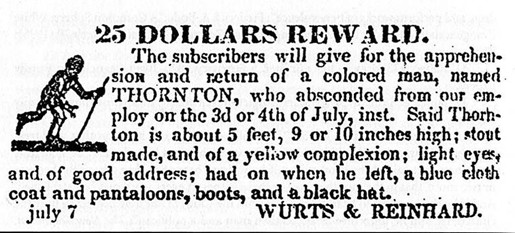
This was a newspaper all-points bulletin for when Thornton made a break for freedom.
But freedom in the North was fragile. In 1833, a traveler from the South recognized Thornton, leading to the couple’s arrest in Detroit. Imprisoned and facing extradition back to Kentucky, they prepared for the worst.
With support from Detroit’s abolitionist community, Lucie escaped through a clever disguise and was ferried across the river to Amherstburg (now part of Windsor), Upper Canada. A crowd later freed Thornton, who also reached Canada. When Michigan demanded their extradition, Upper Canada’s lieutenant governor refused, reinforcing Canadian law that prohibited extraditing anyone to face a punishment harsher than what existed in Canada for the equivalent offense. This landmark decision helped establish Canada as a true safe haven for freedom seekers.
Seeking distance from the border, the Blackburns sailed to York (soon renamed Toronto) in 1834, arriving via the harbour. They found work, reunited with family, and quickly built a life.
Thornton found work as a waiter in Osgoode Hall’s dining room. It was an excellent place to get to know who the important players in town were, make contacts, overhear gossip and learn of opportunities. As a team, the Blackburns worked very well. Thornton was enterprising and full of ideas and Lucie was an excellent money manager. And it wasn’t long after their arrival that they began a business that would re-imagine transportation and make them very comfortable.
In 1837, Thornton introduced a hansom cab nicknamed “The City”, launching Toronto’s first taxi service. It was painted a cheerful yellow and a bright red – the same colours the TTC adopted for their buses and streetcars and are still in use today.
With a burgeoning city, and thousands more arriving annually, mostly by ship, Thornton was never without customers in need of a ride. His cheery yellow and red cab could be seen regularly plying its trade along the main street at King and along the wharves of Front Street.
Demand surged, imitators followed, and Thornton and Lucie hadn’t just started a business, they started a new industry. One that thrives to this day as taxi companies and more recently ride-share companies like Lyft, Uber and Hopp.
The Blackburns operated their taxi business for about 30 years. But beyond business, the Blackburns became pillars of the community. Their Eastern Avenue home served as an Underground Railroad stop; Thornton served as a delegate at the 1851 North American Convention of Coloured Freemen at St. Lawrence Hall; and they helped with the construction of little Trinity Anglican Church. They also invested in real estate, aided newcomers, and advocated for civil rights.
Thornton died in 1890 and Lucie in 1895, leaving a legacy of resilience and enterprise.
And their cab? According Karolyn Smardz Frost in her book “I’ve Got a Home in Glory Land”:
“Thornton’s old taxi had been given during his lifetime to the historical society, the York Pioneers. It was used for many years as an outdoor exhibit in front of Scadding Cabin on the grounds of the Canadian National Exhibition. The old Blackburn cab now devoid of its bright paint and itself “grey with wind and weather,” remained with the society until about 1960, when it seems to have been discarded.”
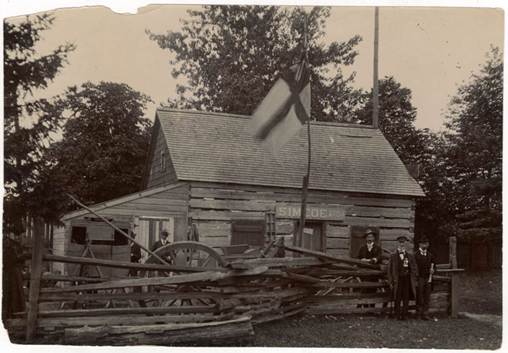
Scadding Cabin (at the CNE) with Thornton’s long-retired cab parked outside of it.
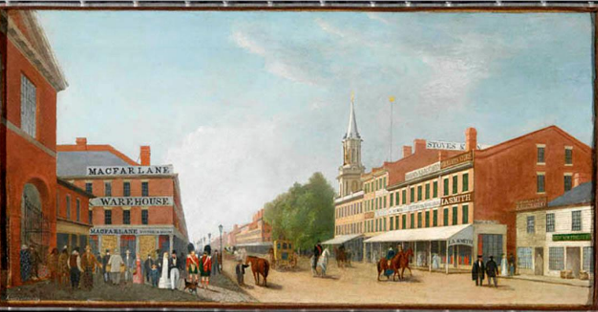
But for those who wonder what it looked like in operation, there is a tiny window where it can be grasped. Painted by Toronto artist John Gillespie in 1844 is a street scene in Toronto. On King Street, near St. James, can be seen, square in the centre of the image, the bright yellow cab – “The City” and, seen in a shadowy silhouette, its driver, Thornton Blackburn.