Port of Toronto Ship Channel Bridge – Rehabilitation Project
In March 2022, the Toronto Port Authority in partnership with the City of Toronto began a major rehabilitation program to modernize the ageing Ship Channel Lift Bridge, a vital piece of infrastructure supporting Toronto’s supply chain.
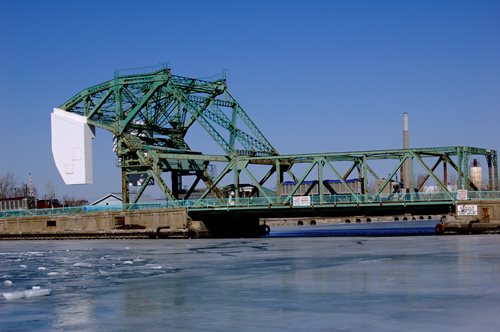
Through this project, the Toronto Port Authority jointly with City of Toronto, will restore and revitalize the Ship Channel Lift Bridge, a vital element of marine and vehicle transportation infrastructure enabling the transfer of cargo from the Port into the City of Toronto and surrounding area. It is necessary to rehabilitate this bridge, originally constructed in 1931, in order to maintain marine transportation of bulk commodities such as road salt, cement or aggregates to the Port of Toronto.
By operating the port and promoting shipping as a more efficient and sustainable alternative to delivering goods to Toronto, the Toronto Port Authority is working to minimize the road traffic and related greenhouse gas emissions that result from transporting goods by truck. A vital piece of infrastructure supporting this supply chain, the Ship Channel Lift Bridge provides access to the shipping channel to allow safe and reliable transport and unloading of bulk commodities, and connects cargo to other modes of transport. Should the bridge become non-operational due to its rapidly deteriorating condition, it would prevent vessels from accessing businesses located along Ship Channel and would move all their cargo to less environmentally-friendly truck transport.
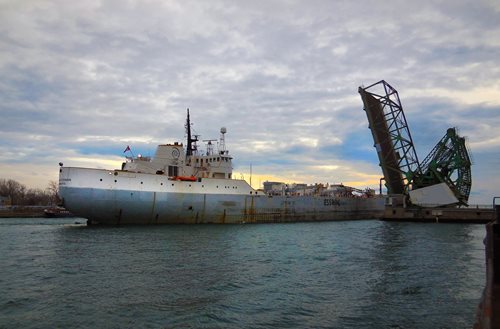
This project will modernize three key components of the aging structure and is expected to be completed in 2028. Most work in Phases 2 and 3 will occur during winter months when the Ship Channel Bridge is closed to marine navigation. Throughout the project, the Toronto Port Authority will maintain cargo transportation across the Ship Channel, and keep vehicle and pedestrian access available where reasonably possible, with safety as the highest priority.
The Toronto Port Authority consults with the Mississaugas of the Credit First Nation on all projects.
If you have questions about this project, contact communications@torontoportauthority.com.
Phase 1 (completed March 2024): Rehabilitation of the north and south roadway approaches.
Phase 2 (completed March 2026): Structural steel repair, cleaning, and coating
Phase 3: Replacement of end-of-life mechanical and electrical lift systems; remaining cleaning and coating
A Greener Alternative to the Movement of Goods
The most efficient and cost effective way to move bulk commodities over large distances is by water. In fact, one tonne of freight can travel 240 kilometres on a single litre of fuel by ship, whereas it can travel only 30 kilometres by truck. In an average year, over two million tonnes of cargo transit through the Port of Toronto, taking tens of thousands of trucks off Ontario’s already congested highways. Every tonne of road salt, cement and aggregate moved into the Greater Toronto Area by ship significantly reduces GHG emissions relative to the same tonnage of materials transported by truck.
In addition to its environmental and operational benefits, modernizing the Ship Channel Lift Bridge will enable the Port of Toronto to attract increased tonnage of cargo, increase shipments of heavy single components consignments and increased cruise ship passenger volumes. Further, it will increase the utilization of the existing terminal warehouses, cruise passenger terminal facilities and bonding/brokerage facilities.
History of the Ship Channel Bridge
The Cherry Street Bascule Bridge located on Cherry Street, south of Polson Street, carries two lanes of traffic (one northbound and one southbound), as well as sidewalks on both sides, over the Ship Channel in the Port of Toronto. The bridge was constructed in 1931 and consists of a 37-metre-long Warren Through Truss Bascule span (a lift bridge activated by counterweights) and a 43-metre-long steel girder approach span on both the north and south ends. The north end of the bridge has 750-ton concrete counterweights that allow the bridge to pivot to the open position to allow ships to access the channel.
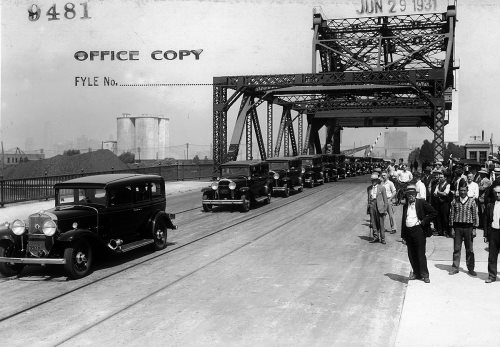
The Ship Channel Bridge, photographed at its opening on June 29, 1931. (the Toronto Port Authority Archives)
The total length of the bridge is 123 metres and the substructure consists of concrete abutments founded on timber piles. This bridge is the primary roadway connection to the southern Port Lands area (the only other being the single lane Unwin Avenue Bridge). Operational lifting of the Bascule span provides critical access that allows ships to access the channel and the turning basin beyond.
The bridge type was designed by American structural engineer Joseph Baermann Strauss, best known as the engineer responsible for the Golden Gate Bridge. This structure is a representative example of a bridge type that is exceptionally rare in Canada and is listed as a heritage structure by the City of Toronto.